Prologue
What this site is — and why
"AKTE LEIPZIG" is for lovers and haters of the Red Bulls alike. History becomes legend, legend becomes myth. And myth becomes cult — or a reason for eternal second-hand embarrassment, depending on the event.
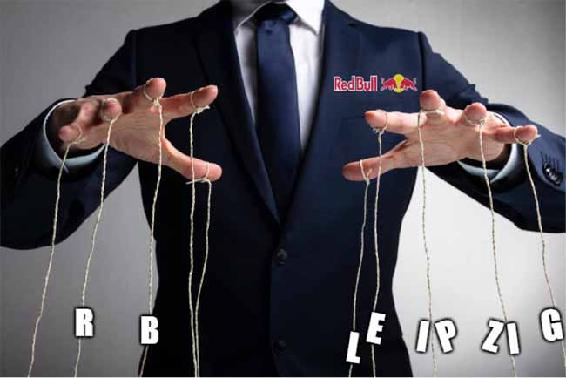
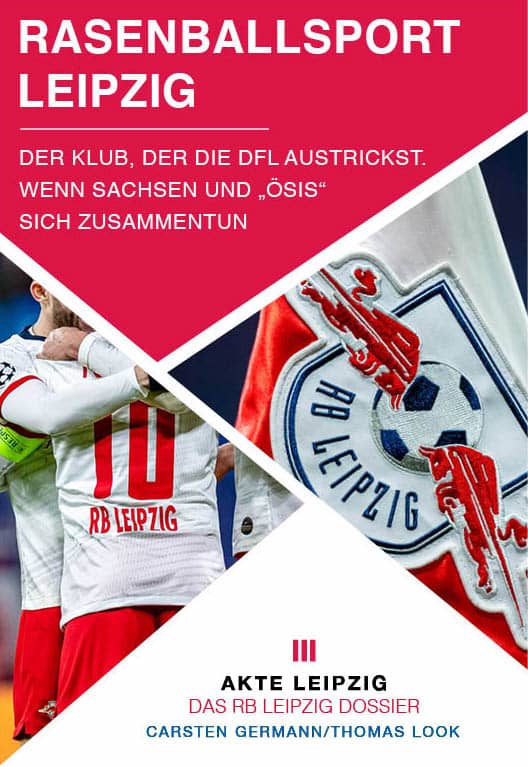
The club that outsmarted the DFL. When Saxons and Austrians join forces. Red Bull bought a club, rocketed from the fifth division to the Bundesliga in record time and became an instant title contender. The purists hate it, the pragmatists admire it — and RB Leipzig proves you can play top-level football without 100 years of tradition. Champions League semi-final 2020, DFB-Pokal winners 2022 and 2023 — the project delivers.
But this site goes beyond mere celebration or hatred. Akte Leipzig is structured in three parts: The Club Dossier tells the story — triumphs, tragedies, scandals, heroes and failures across 12 chapters. Match Intelligence delivers the live data a professional needs: squad, statistics, head-to-head, injuries, form. And Predictions brings it all together — with prediction markets.
Prediction markets are not gambling. In traditional sports betting, the masses lose — the money goes to the bookmaker who has built in his margin. Betting exchanges are similar: commissions on winnings, liquidity shortages and spread eat into returns. Prediction markets work fundamentally differently. There is no bookmaker who lets the house win. Instead, money flows from those who don't know to those who get it right — with risk management, portfolio diversification and disciplined capital deployment. You can trade 24/7, build and close positions, and wait for the binary resolution of the event. Those who understand it are not speculating — they're engaged in systematic trading.
Akte Leipzig is part of Akte Bundesliga — the same concept for all 18 Bundesliga clubs. Each club gets its own dossier, its own intelligence, its own predictions. The big picture can be found at aktebundesliga.net.
Profile
Facts, figures and milestones
Steckbrief – Facts, figures and milestones
RasenBallsport Leipzig e. V., known as RB Leipzig (RBL or the "Red Bulls"), have only played in the Bundesliga since the 2016/17 season. After Union Berlin and SC Paderborn, RB Leipzig are currently (as of 2019/20) the club with the shortest spell in Germany's footballing elite. The "Red Bulls" play their home matches at the Red Bull Arena. The 2006 World Cup stadium in the east of the city holds 42,959 spectators.
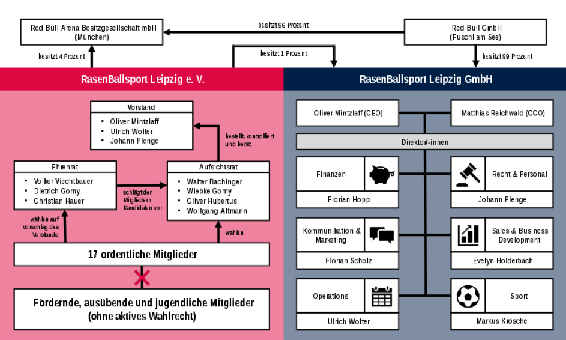
The club was founded in 2009 on the initiative of Red Bull GmbH and took over SSV Markranstädt's spot in the fifth-tier Oberliga Nordost for the 2009/10 season. The professional squad and youth teams down to U15 level have been spun off into RasenBallsport Leipzig GmbH since the first team's promotion to the 2. Bundesliga in 2014, with Red Bull GmbH holding 99 per cent of the shares.
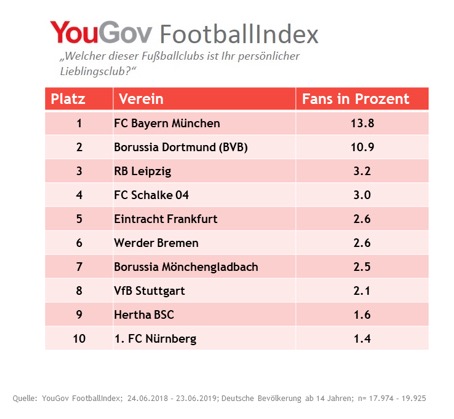
Due to its club structure and the accusation of being a "club without tradition," RB Leipzig is among the most polarising football clubs in Germany, provoking intense positive and negative reactions. In surveys by YouGov (June 2019) and Nielsen, the club consistently ranks third among the most popular German football clubs — behind Bayern München and Borussia Dortmund — but simultaneously among the most disliked.
Proof: In a 2018 survey by the Technical University of Braunschweig asking about the most likeable football clubs in Germany, RB Leipzig finished second to last. SC Freiburg, FC Augsburg, Borussia Mönchengladbach, Union Berlin and Mainz 05 were rated the most likeable Bundesliga clubs.
Bundesliga popularity table 2018: 1. SC Freiburg, 2. Holstein Kiel, 3. SV Sandhausen, 4. Jahn Regensburg, 5. FC St. Pauli, 6. FC Augsburg, 7. SpVgg Greuther Fürth, 8. Borussia Mönchengladbach, 9. Union Berlin, 10. FSV Mainz 05, 11. 1. FC Köln, 12. Erzgebirge Aue, 13. TSG 1899 Hoffenheim, 14. SC Paderborn, 15. Borussia Dortmund, 16. 1. FC Heidenheim, 17. SV Werder Bremen, 18. 1. FC Nürnberg. Bottom three: Hertha BSC, FC Bayern and — last — RB Leipzig.
RB Leipzig's survey figures reveal that the club provokes far stronger feelings than many other Bundesliga sides. According to a 2017 Statista survey, 48% of football fans surveyed held a neutral position on RB. 28% opposed the club, while 24% were supporters. This makes RBL roughly as polarising as FC Bayern.
Good to Know
What few people know
RB Leipzig is a football club controlled by the Austrian Red Bull corporation. That is well known. How the fizzy drinks billionaire cunningly exploited loopholes in the DFB and DFL regulations to build a Bundesliga contender from scratch — that is less well known.
On the path to the Bundesliga, the brains behind the RBL coup cleverly circumnavigated the gaps in the DFB and DFL rulebook. The 50+1 rule, which was supposed to prevent investors from taking majority control of a club, was rendered toothless: RB Leipzig technically has only 21 members with voting rights — all of them Red Bull employees or associates. Joining as a regular member? Virtually impossible.
Just days before the second-division licence was granted, RB owner Dietrich "Didi" Mateschitz made one final concession to the German football authorities: the word "Red Bull" disappeared from the club name and was replaced by "RasenBallsport" — lawnball sport. The bull logo stayed, the colours stayed, the money stayed. Only the name changed.
RB Leipzig is the copy and RB Salzburg the original, with which the fizzy drinks billionaire set out to dominate football in the German-speaking world. Salzburg serves as the blueprint, the development lab and the feeder club. Players are shuttled between the two sister clubs as needed — a system that gives Leipzig a scouting and development pipeline most Bundesliga rivals can only dream of.
That is how it is portrayed in the fan curves of unsuccessful traditional clubs and in the tradition-romanticising German media. The reality is more nuanced. RB Leipzig has invested heavily in youth development, infrastructure and coaching — and has produced a playing style that is admired across Europe.
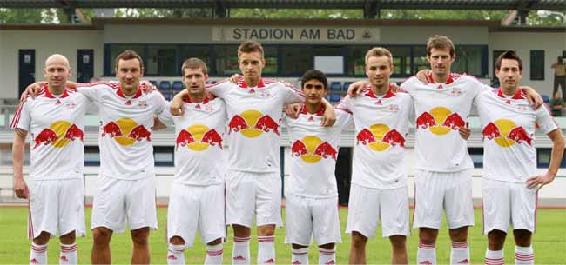
Red Bull's footballing philosophy is said to be set in stone, and every single coach, every single employee must adopt it. The system is built on high pressing, rapid transitions and an extreme work ethic. The Red Bull philosophy: "We want to play the most spectacular and fastest football in all of Europe."
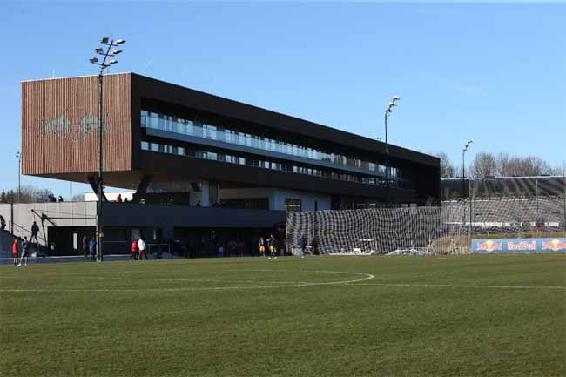
This playing system is to be perfected through a high-tech complex with six football pitches, an indoor hall, a weights room, video analysis suites and a sports science department — all housed at the Cottaweg training ground in Leipzig.
The athletics room — with a special sprint training device where players strap belts around their hips, connected via cables to a motorised resistance machine. The sprints are analysed in real time and the data fed directly to the coaching staff.
The high-tech weights room with video workout — directly beside a running track stand 13 workstations for strength training. Players can follow individual exercise programmes on video screens. Every repetition is monitored and recorded.
For the Haters
Embarrassing disasters and major defeats
"El Plastico": The Red Bulls' heaviest Bundesliga defeat — as of December 2019 — came in the German "Clásico" against Bayern München: a 0-5 thrashing in the 2017/18 season. The nickname "El Plastico" was coined by fans mocking the rivalry between two investor-backed clubs.
The DFB-Pokal long seemed tailor-made for RBL's opponents: in 2015, a heavy defeat at third-division Unterhaching. In 2016, elimination at fourth-tier Sportfreunde Dorfmerkingen. Embarrassments that delighted every RB critic in the land.
SV Sandhausen: Of all clubs, the self-proclaimed "league dwarf" SV Sandhausen shot the "Bulls" to their highest home defeat — a 2-4 loss at the Red Bull Arena in the 2014/15 2. Bundesliga season.
Draw against Trondheim: It was the final matchday of the 2018/19 Europa League group stage. Although "sister club" RB Salzburg beat Rosenborg 2-0, Leipzig only managed a 1-1 draw against the Norwegians — and were eliminated. The Europa League adventure was over before it had truly begun.
Although RB Leipzig have only existed since 2009, the club have accumulated some notable negative records in the top two German divisions.
Worst league finish in club history: In 2017/18, 53 points in the Bundesliga were only enough for 6th place. The previous season's runners-up slipped dramatically.
Most defeats: In 2017/18, the "Red Bulls" suffered eleven Bundesliga losses — a club negative record.
Most goals conceded: No, the 2017/18 season was not RB Leipzig's finest! 53 goals conceded remain the worst defensive record in the club's Bundesliga history to date.
Worst goal difference: With a goal difference of plus four (57:53), Leipzig still scraped into the European places in 2017/18 — barely.
For the Lovers
Key triumphs and major victories
Most successful newcomer in Bundesliga history: RBL's runners-up finish in 2017 eclipsed the "all-time record" of 1. FC Kaiserslautern, who finished 7th in their debut Bundesliga season in 1963/64. Leipzig went one better: second place and Champions League football in their very first year.
Leipzig loves Berlin: Look away, Hertha fans, but the football capital of eastern and central Germany is Leipzig, not Berlin. In Bundesliga history (to December 2019), the Red Bulls have never lost at Hertha BSC's Olympiastadion.
More bad news for Hertha fans: Hertha's reserves also struggle against Leipzig. In lower-league encounters, RBL dominated Berlin's second team repeatedly on their way up through the divisions.
The biggest Bundesliga win: The Bulls celebrated a goal fest against FSV Mainz 05 on November 2, 2019 — an 8-0 demolition that sent shockwaves through the Bundesliga.
"Bulls" as cup giant-killers: July 29, 2011 — the Red Bull Arena hosted RBL's DFB-Pokal debut. The then fourth-division side beat Bundesliga outfit VfL Wolfsburg 3-2 in a sensational first-round upset.
Never again Oberliga! The RBL newcomers took this German amateur football evergreen literally and shot their way out of the fifth tier at the first attempt — with 89 goals in 30 matches and immediate promotion.
RB Leipzig's greatest success came as Bundesliga newcomers in 2016/17: under coach Ralph Hasenhüttl, the team stormed to runners-up spot — the best debut season by any promoted club in Bundesliga history.
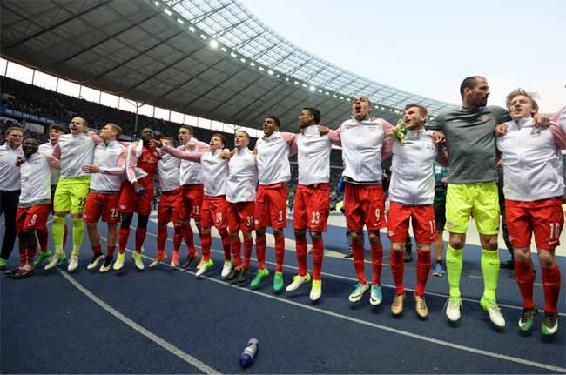
DFB-Pokal final: Reaching the 2019 final represented the young club's best cup run at the time. Leipzig lost 0-3 to Bayern München at the Olympiastadion in Berlin — but the journey itself was a statement.
Sachsenpokal final: Before that, Leipzig reached the Sachsenpokal final in 2011 and 2013 — each time as a Regionalliga side (1-0 and 0-2 against Chemnitzer FC). Modest trophies, but milestones on the road to the top.
Most Important Persons
The men who shaped the club
The promotion hero: "Domme" played through four leagues during his six-year stay at Leipzig. The midfielder joined RBL from Hoffenheim for the 2012/13 Regionalliga Nordost season. He rose through the ranks with the club to the Bundesliga, serving as captain along the way — a symbol of the project's rapid ascent…
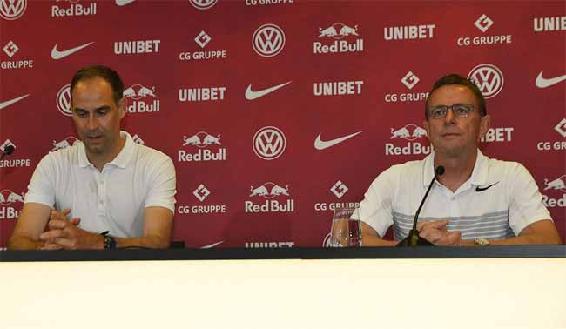
RB Leipzig has a lot of money — and good, clever people. One of them is Oliver Mintzlaff. The former long-distance runner and Puma manager served as "Head of Global Soccer" at Red Bull GmbH from 2014 to 2017, before becoming CEO of RB Leipzig. Under his leadership, the club consolidated its position in the Bundesliga elite…
The reliable one: The Swabian has been leading the line for the Leipzig Bulls since 2016, scoring in almost every other match. By the end of 2019, he was by far the record goalscorer for the Bulls in the Bundesliga, having netted 50 goals in his first three years and consistently finishing as the team's top scorer…
The professor: Since 2012, Rangnick has served as sporting director for Leipzig. He oversaw the promotions to the 3. Liga (2013) and 2. Bundesliga (2014), before also stepping in as head coach in the 2015/16 and 2018/19 seasonsommt. Der „Fußball-Professor“, seit einem legendären Sportstud…
The billionaire: Dietrich Mateschitz was an Austrian entrepreneur. And a billionaire. Through his Distribution & Marketing GmbH, he held 49 per cent of the shares in Red Bull GmbH. His fortune was estimated at 23 billion US dollarshätzt: Stand Forbes Liste - The World’s Billionaires 2018. Mat…
Personae Non Gratae
The men fans love to hate
The groper: In the 74th minute of a heated match against FC Augsburg in 2017, Daniel Baier went down after a challenge roughly ten metres from the Leipzig bench. Getting up, he first spat towards the coaching staff on the touchline, then made a crude grabbing gesture towards a member of the RBL staff. A moment of madness that earned him infamy…
Joachim Watzke — The critic: "They play football to promote a drinks can," Watzke said dismissively about the Leipzig promotion squad. Time and again, the CEO of the only stock-listed Bundesliga club criticised the RB model — while presiding over a club with its own significant commercial interests…
Tragic
Those who suffered misfortune
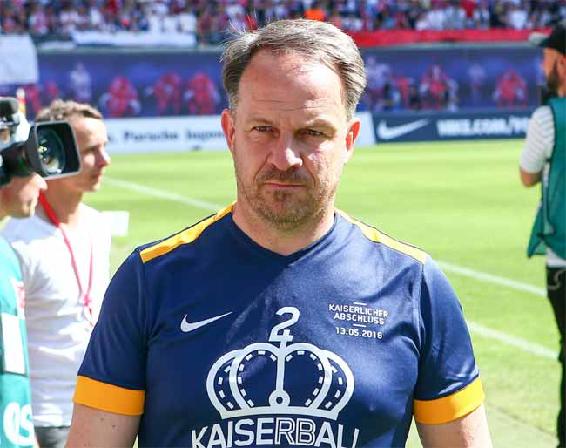
Alexander Zorniger — The maverick tactician: Alexander Zorniger is a German football coach with a maverick philosophy. After various stops in southern Germany, including a stint as Markus Babbel's assistant at VfB Stuttgart, Zorniger became head coach at RB Leipzig on July 3, 2012. He succeeded Austrian Peter Pacult, who was dismissed by new sporting director Ralf Rangnick. In his first year, Zorniger led Leipzig to promotion to the 3. Liga in 2013 and the 2. Bundesliga in 2014. But his relationship with Rangnick grew increasingly strained, and the two clashed over the team's direction.
Rolf Gall — The courageous electrician: An electrician provided the spark for Red Bull — Roland Gall is the man's name. "I don't want to take credit I don't deserve, but I opened the door," the retired master electrician said in a 2015 interview. Gall, a fan of BSG Chemie Leipzig, desperately sought sponsors for his beloved club in 2006 — and ended up at Red Bull in Austria. When he was rebuffed, he turned to Dr. Michael Kölmel, the owner of today's Red Bull Arena. Kölmel saw the opportunity and the connection was eventually made.
OMG — Oh My God
You can't be serious
That the "Red Bulls" face not just rejection but outright hatred at away matches in particular is one of the less edifying constants of German football culture. Banners, chants and protests accompany RBL wherever they go.
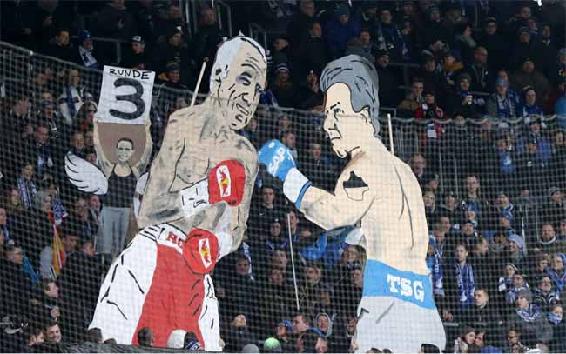
Dortmund and the yellow wall of shame: "Scapegoat of the football nation" — from their very first appearance in 2009, RBL have been targeted by opposing fans with banners, insults and boycotts. The BVB's "Yellow Wall" has been particularly creative in its hostility, producing some of the most notorious anti-RB banners in German football.
Slogans, nothing but slogans: RB Leipzig is one of the most ambitious projects in German football — but sometimes also the most ridiculed. From "You're not a real club" to "No tradition, no passion" — the verbal attacks have become part of the RBL matchday experience.
The thwarted fair play award: RB were involved in — and benefited from — the last abandoned DFB-Pokal match to date. When Osnabrück fans threw objects onto the pitch during the 2014 first-round tie, the match was called off with Leipzig leading. RBL were awarded the win — and promptly nominated for a fair play prize. The irony was lost on nobody.
Row over the Zlatan-esque shirt: Leipzig, July 18, 2014. Paris Saint-Germain became the first international top club to visit the Red Bull Arena for a friendly. But the main talking point was not the match itself — it was the controversy over whether RBL could sell replica shirts featuring the visitors' star player Zlatan Ibrahimović.
Fun Facts
Knowledge for blowhards, braggadocios and connoisseurs
That RasenBallsport Leipzig should really be called Red Bull Leipzig is common knowledge. But not everything about the "canned club" is as well known as you might think.
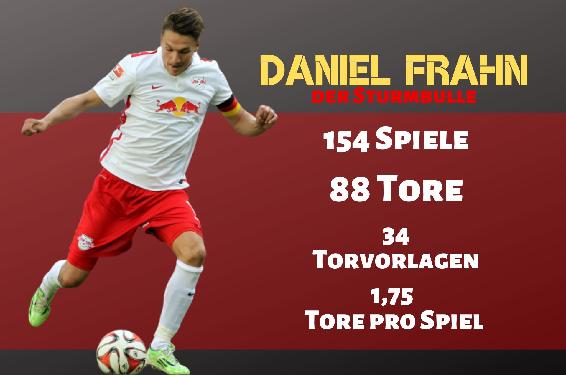
Daniel Frahn — The bull striker: No other player had scored more goals in a single season for the "Red Bulls" than Daniel Frahn by the end of December 2019. The striker was the star of the early years, netting prolifically during the club's rise through the lower leagues.
Attendance record on a day of shame: At the fan-protest-marred 0-1 loss at Borussia Dortmund on the second matchday of the 2016/17 season, 81,360 spectators packed the Signal Iduna Park — the highest attendance for any RBL match in history. The atmosphere was hostile in the extreme.
After Diego, nothing comes close: On October 26, 1988, SSC Napoli with superstar Diego Armando Maradona visited Leipzig's Zentralstadion. Over 85,000 spectators watched the UEFA Cup tie — the largest crowd in the stadium's post-war history for a football match.
Salzburg branch — RB Leipzig's transfer flows are easy to trace: The young club signed 16 players from sister club RB Salzburg between 2009 and December 2019, making the Austrian side by far the most important feeder club.
Sold out: With 41,795 spectators, the Red Bull Arena was sold out for the first time for a competitive match — the home game against FC St. Pauli in the 2015/16 2. Bundesliga season. The "cult club vs canned club" narrative ensured huge demand.
The first name comes from Maradona: Diego Demme joined RB Leipzig from SC Paderborn 07 in 2014. He played in the 3. Liga, the 2. Bundesliga and the Bundesliga for the Red Bulls. His parents named him Diego after Diego Armando Maradona, whose World Cup triumph in 1986 fell in the year of Demme's birth.
Special Moments
Keiner will die Red-Bull-Millionen!
"Will you stay for a beer?" — This question caught Rolf Heller, president of FC Sachsen Leipzig, off guard one summer afternoon in 2006 during a match in Leipzig's west end. The man inviting him for a pint was Rolf Gall (65), a retired electrician and 25-year member of BSG Chemie Leipzig, a man with a nose for opportunities.
For money in Leipzig was tight. After German reunification, the "Chemists" — who had twice represented DDR football in European competition — merged with Chemie Böhlen to form "FC Sachsen Leipzig." In 2001, the club went bankrupt and in 2004 moved from the old Chemie stadium Alfred-Kunze-Sportpark into the completely rebuilt Zentralstadion.
In the years after the 2006 World Cup and the preceding 2005 Confederations Cup dress rehearsal, the Zentralstadion was considered a white elephant. "Dance of the dead in the theatre," as DER SPIEGEL put it, whenever Sachsen Leipzig played Regionalliga Nord matches there in front of empty stands. As early as 1999, the club could only survive through a partnership with the stadium operator Michael Kölmel.
That was the situation in which "Sachsen-Galli," as they called Rolf Gall in Leipzig, encountered Heller. Heller lamented the club's woes over a beer. "Something must be done," the electrician replied — inspired, perhaps, by the legendary Peter Alexander lyric: over beer and spirits, many find solutions to all life's problems.
And RB Salzburg was the club that had taken over the licence of SV "Casino" Salzburg in 2005 and turned the cosy but dull Austrian football world upside down. What did Gall do? He copied the company address from a Red Bull energy drink can and wrote a letter to Red Bull founder Dietrich "Didi" Mateschitz. "The worst they can say is no," he figured.
"Sachsen-Galli" even received a reply. "We regret that we must decline your enquiry as a shirt sponsor," it read, "as we are currently not involved in football projects." But the Leipzig man did not give up. He called Salzburg. "I'd like to speak to Herr Mateschitz," he said — but was passed to a lower-ranking official instead.
But Kölmel had smelled a rat. The costs for the Zentralstadion were threatening to spiral out of control. Kölmel was losing 100,000 euros a month on the stadium. Nearly a million euros were pumped by the stadium company into FC Sachsen Leipzig, who were playing in the fourth-tier Oberliga.
Nuclear physicist Dr. Otto Schlörb, acting on Kölmel's behalf, searched for sponsors and approached Red Bull again on behalf of FC Sachsen. And by now, the situation in Austria had changed completely. Red Bull wanted to invest in German football and had already approached several clubs, only to be turned away. The traditional clubs wanted nothing to do with the energy drink company.
The club representatives were put out, pointing to large and powerful fan scenes that had rather shown solidarity with Austria Salzburg's supporters and protested against the takeover. Austria Salzburg was supposed to be the "role model" for Germany. But no chance.
The Austrians had to rethink. Instead of a German big-city club with tradition, they now sought a club "attached" to a major German city — one without tradition and without a rebellious fan scene, but with potential, playing in as high a league as possible. On a hastily compiled shortlist, to which even Franz Beckenbauer contributed, Leipzig emerged as the frontrunner.
And so nuclear physicist Dr. Otto Schlörb — unlike the sweating electrician Gall in 2006 — was invited to Red Bull's representational building in Salzburg, Hangar 7. These meetings quickly produced a breakthrough. On October 2, 2006, Dany T. Bahar, Mateschitz's right-hand man, contacted Schlörb. The Bulls had taken the bait.
A discreet hotel in Berlin was the venue where Kölmel and his associates presented Red Bull with a viable concept. It was October 4, 2006. Kölmel and Schlörb suspected, however, that FC Sachsen would not accept Red Bull's conditions — among them a change of kit colours from green and white to red and white, a name change, and the sale of naming rights. They were right.
Wise Words
Quotes for eternity
"Every day and every night, we're awake for Rasenballsport. We sing Ayayayayo, Uaayayayayo, Ole ole ola. We're here for Rasenballsport. Every day and every night, for Saxony's new force. We stand together and never alone. For our Leipzig club." RB Leipzig fan chant
"Ralf (Rangnick) wants to go up and I don't."
Ex-RBL coach Alexander Zorniger shortly before his departure"Sportingly, we've poked a hornets' nest. That things are buzzing a bit now is obvious."
Ralph Hasenhüttl — former RB Leipzig coach"Do I give RB Leipzig, a branded club of a canned drink with no tradition, a friendly image? Look, for a coach it's actually no disadvantage when the club has no great tradition. Why? Rarely does someone come around the corner telling you how great everything was 20 years ago."
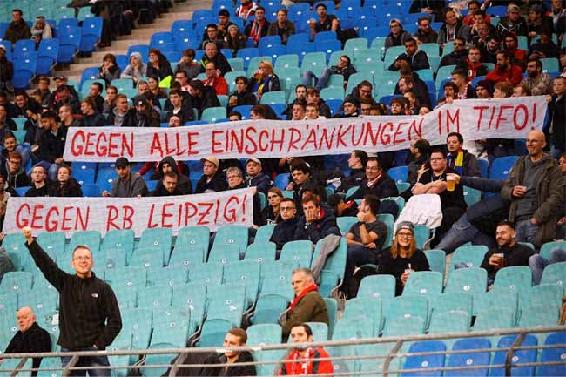
Ralph Hasenhüttl — former RB Leipzig coachBanner protest on the Dortmund South Stand against RB Leipzig. Borussia Dortmund fan banners